Summer 2026 internships available

By Tulwen Adams ’22 & Rebecca Jones ’13

The Center for Environmental Studies at Austin College will offer three opportunities for internships during the summer of 2026. The internships are hosted by the Land Institute, located in Salina, Kansas; Little Traverse Conservancy in Northern Michigan; and the Heard Museum in McKinney, Texas. [Internships at the East Foundation in South Texas are currently on pause — check back next year!]

A degree in environmental studies offers diverse career opportunities, which can feel both exciting and overwhelming. Spending a summer exploring a career helps students narrow their choices and discover new paths. ENVS summer internships offer experience in the developing field of sustainable perennial agriculture with the Land Institute, land conservation and easements with Little Traverse Conservancy, the practice of land and wildlife stewardship alongside ranching with the East Foundation, and land management and ecological research at the Heard Museum.

Past participants describe these programs as an excellent way to gain hands-on experience in environmental studies, explore potential career paths, and learn directly from professionals across diverse fields. 

“Applying for and completing an internship can be one of the most valuable steps you take as a student,” says Rebecca Jones, coordinator for the Center for Environmental Studies. “It’s not just about building your resumé—it’s about discovering what excites you, gaining real-world experience, and making connections that can shape your future.”

Thinking about applying? Here are some tips from past interns about the application process and beyond:

  1. Apply Early. Don’t let the application process interfere with your spring coursework — spend some time over JanTerm or the winter break reading through the AC internship and host organization websites to figure out the best fit for you and get your thoughts on paper. The Center for Environmental Studies will help you handle everything else.
  2. Ask Lots of Questions. Not sure which internship opportunity best suits your career path or goals? Contact an ENVS faculty or staff member to express your interest and concerns. You can also ask other students who have previously held internships — they usually love talking about their experience!
  3. Come Prepared. You’ve officially secured your internship, but what should you pack for the journey? Staples like hats, sunscreen and bug spray are a must for most sites, but many former interns also recommend bringing items that remind you of home. Don’t forget your lucky socks, favorite stuffed animal, comfort food, etc.
  4. Explore and Interact. Many former interns report that one of the highlights of their experience is the people they work with on a day to day basis. Get to know your bunkmates and co-workers, and take the time to visit other locales of interest to make your internship richer, more fulfilling and memorable.
  5. Be Ready to Work Hard. Manual labor is a part of all the internship experiences provided by the Center for Environmental Studies, but that shouldn’t deter you from applying if you have a real interest in the overall mission and/or goals of the host organizations. It’s also important to remember that you are a representative of the college when you are at these sites, so act accordingly!

For more information on the host organizations and application process, please visit the internship section on the Center for Environmental Studies webpage.

My Summer at the East Foundation

By Kabyl Utley ’24

Kabyl Utley (left) and another intern at the East Foundation.

This past summer I was given the opportunity of interning for the East Foundation for two months. The East Foundation is an organization that promotes the advancement of land stewardship through ranching, science, and education. They are a working cattle ranch, managing over 217,000 acres in South Texas. Here, scientists and ranchers work side by side to address the problems that are important to wildlife management, rangeland health, and ranch productivity.

I always knew Texas was a huge state, so it was no surprise to me that I would have to drive around six hours from my home in central Texas to the ranch where I would be working. The ranch that I worked at encompassed more than 150,000 acres and was located in the South Texas Sand Sheet. The change of scenery from central Texas to the ranch was absolutely mind blowing. Beautiful flowering cacti and plants dotted the sides of the highways. The plant life there was very pretty, except for the fact that essentially every plant has spines or thorns of some sort.

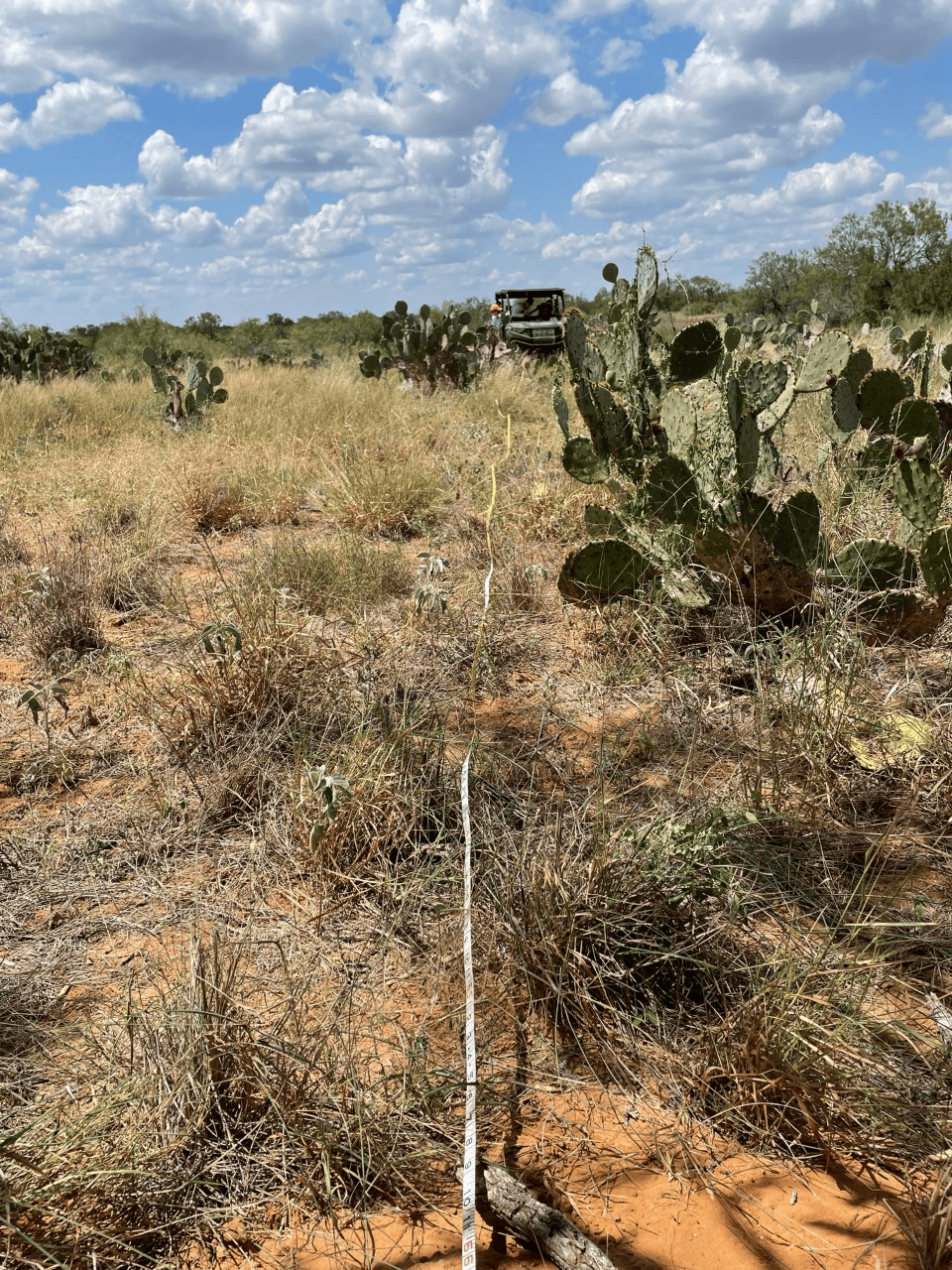
A typical workday in the punishing south Texas sun.

I’m not originally from Texas, so I haven’t been around cattle ranches that much up until this past summer. Working on the ranch as a “Ranch Ecology Technician” was one of the greatest experiences I have ever had in my life up until this point. The never-ending sandy dunes of the South Texas Sand Sheet, along with the beautiful wildlife that scattered the hundreds of acres were simply amazing to witness. I worked alongside three other interns, along with many other groups of scientists who worked on different research studies around the ranch. I was even lucky enough some days to even go out with some of these different groups to help them out with their research.

My tasks as an intern focused on collecting data for two different research studies. The first research study was determining the amount of preferred and nonpreferred vegetation present around the ranch. We did this by collecting data at about 100 different points at various set locations at the ranch. Our supervisor would then use this data to determine the stocking rates of the cattle for the next few years, along with seeing if the current ranching techniques are sustainable or not. Our second research study focused on the population and habitat quality of the bobwhite quail on the ranch. We did this by visiting 140 set points around the ranch, using various factors such as woody density, bundle grass size/density, and vegetation height, to then determine whether or not bobwhite quails have available quality nesting sites.

My favorite experience from the entire internship was being able to see the wildflowers bloom after a rainstorm one night. Because I live in such an urbanized town, I am not used to seeing native wildflowers and plants bloom after it rains, so being able to witness such a beautiful thing was amazing. Being able to just step outside of headquarters on the ranch and see hundreds of stunning, unique flowers dotting the landscape was truly spectacular and peaceful. It was one of those moments where you kind of just stand there and soak in the beauty that life is and the beauty that it brings with it. It was moments like these that I was grateful to be given the opportunity to intern at a place like the East Foundation.

css.php